
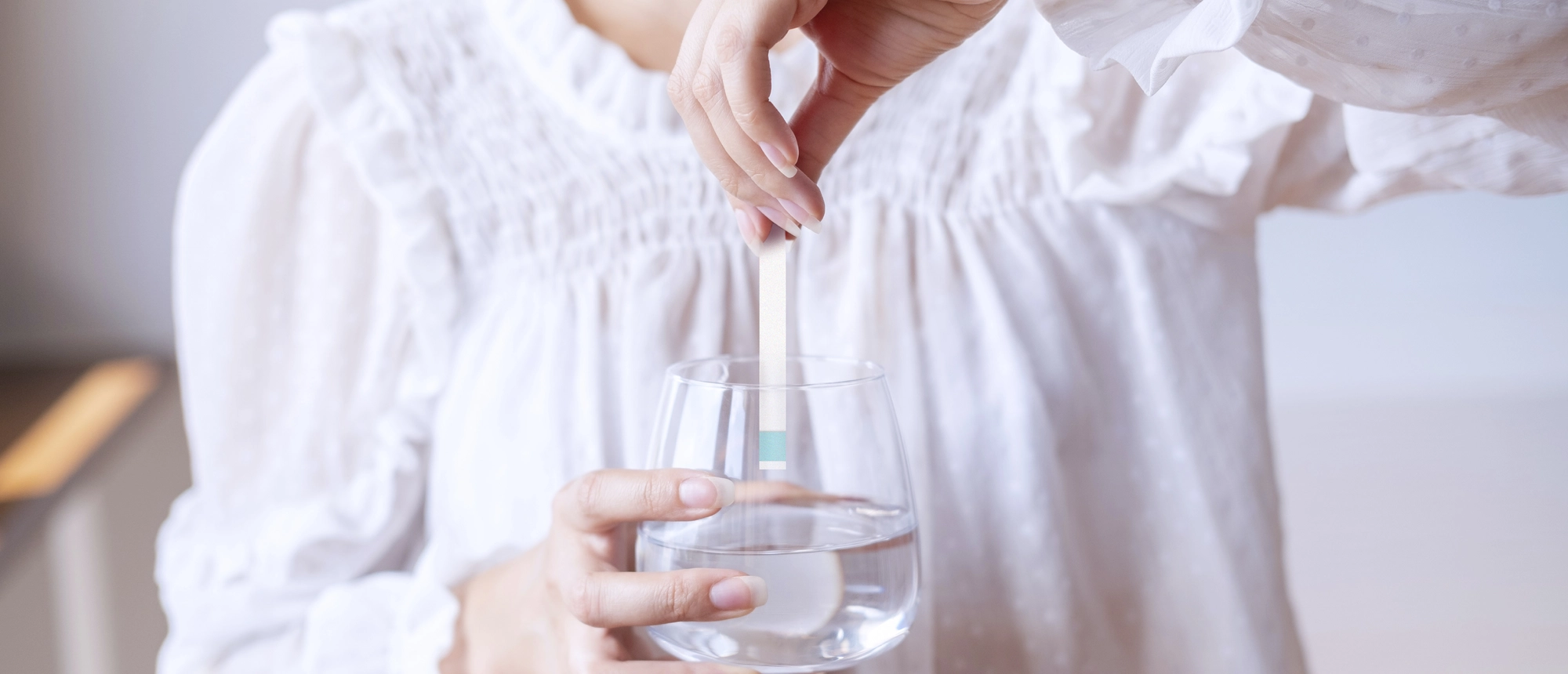
Testing water hardness – why and how to measure the hardness level
Water hardness plays a crucial role in the quality of your water and the protection of your household appliances. A water hardness test helps you determine the calcium concentration in your tap water and identify potential problems early on. Whether using test strips, online calculators, or a professional analysis, there are many ways to accurately measure water hardness. This article explains why water hardness is important, how to test it, and which tools are available in Switzerland.
Water hardness has a significant impact on daily life. Hard water can lead to limescale buildup in household appliances, pipes, and faucets, while softer water reduces these problems. For households that value efficient appliances and high-quality drinking water, determining the water hardness is an important first step.
To determine if there is a (potential) problem and how significant it is, the water hardness must first be measured. A water hardness test is the first step towards better water and optimal water quality in your home. With our tools and tips, you can quickly and easily determine the water hardness in your home.
Do you know if you are affected by hard water and therefore have to deal with limescale buildup? There are several ways to determine water hardness:
Water hardness test strips
These deliver quick and easy results directly from your tap.
Online water hardness calculator
After extensive research and work, Mediagon has created a database containing almost all postal codes in Switzerland, including their water hardness. Enter your postal code to get an overview of the water hardness in your region.
Titration sets
There are kits on the market that allow you to determine water hardness by titration. Such a kit typically contains two bottles of titration solution and a test tube. This method provides precise results and is particularly suitable for households that require exact readings.
Professional analysis
For a detailed investigation, a drinking water analysis by water specialists is recommended.
Test strips are a convenient way to test water hardness at home. Simply dip the strip into water, compare the color to the scale, and instantly get a result indicating the calcium content of your tap water.
Are you interested in a water hardness test strip? Then you can order your free water hardness test strip for Switzerland here , and we will send it to you by post.
A practical tool for determining the water hardness in your area is a postcode-based water hardness search. In regions with a high proportion of groundwater and spring water, the water is generally harder, while areas that rely more heavily on treated lake water tend to have softer water. In Zurich, for example, the water is usually moderately hard, while households in Basel struggle with particularly hard water. An online water hardness calculator allows you to quickly and easily determine the average water hardness in your region.
Find water hardness
No results were found.
Water hardness in :
soft
medium
hard
Water hardness in Switzerland is classified into four levels. In your region, the water hardness is *. This means your water hardness is within a good range. It's not hard enough to cause any problems in your home. Nevertheless, our water treatment systems can be used to revitalize your water and protect it against Legionella.
Water hardness in Switzerland is classified into four levels. In your region, the water hardness is [level] *. This means that limescale deposits from the relatively hard water in your home can cause problems. These include energy loss, a shorter lifespan for appliances, and increased cleaning effort. Our Mediagon limescale protection devices can help protect your home.
Water hardness in Switzerland is classified into four levels. In your region, the water hardness is [level] *. This means that limescale deposits from the hard water in your home can cause problems. These include energy loss, a shorter lifespan for appliances, and increased cleaning effort. Our Mediagon limescale protection devices can help protect your home.
Water hardness in Switzerland is classified into four levels. In your region, the water hardness is [level] *. This means that limescale deposits from the hard water in your home can cause problems. These include energy loss, a shorter lifespan for appliances, and increased cleaning effort. Our Mediagon limescale protection devices can help protect your home.
* The values are derived from data published online by various municipalities in Switzerland regarding water hardness. Mediagon Water Treatment has collected and made this data available to you. It is possible that some of the data may no longer be up-to-date, for example, due to a change in the water source. Therefore, these values are intended only as a preliminary guide.
Providing this data is voluntary for each water supplier and municipality. This may mean that your water hardness information is not yet available or is not up to date. Water hardness is expressed in French degrees of hardness (°fH).
Has your municipality not published the water hardness, but you still want to find out your exact water hardness? Then you can request your free test strip here , and we will send it to you by post.
Water hardness is usually given in French degrees of hardness (°fH). However, in some countries, including Germany, it is more common to give water hardness in German degrees of hardness (°dH).
Importance of water hardness for household appliances
Many household appliances, such as kettles, washing machines, and dishwashers, also use °dH as a measure to maximize their lifespan and efficiency. Appliance manuals and descaling recommendations are often based on °dH, making it easier to understand water hardness in this unit.
Therefore, if you are working with °fH but need °dH, converting the values quickly and reliably can be a challenge.
With our online water hardness converter, you can easily convert water hardness from °fH to °dH. This not only provides an accurate conversion but also saves you time and effort if you regularly work with different unit systems.
Our calculator allows you to flexibly switch between the two units and display the appropriate water hardness according to your needs.
